A volatility label describes variation in a game’s outcomes within the source’s own terminology; it does not schedule a win or tell an individual what will happen next. To read it responsibly, preserve the exact label, its heading and any explanation of the scale. The official documents checked here do not establish a universal conversion between every publisher’s low, medium or high wording.
Sources: Live return to player performance monitoring of games of chance - How to calculate return to player (RTP) GAME COVER Games | JILI Games
Talang Laro Editorial Desk / Published 2026-10-31 / Source review 2026-10-31
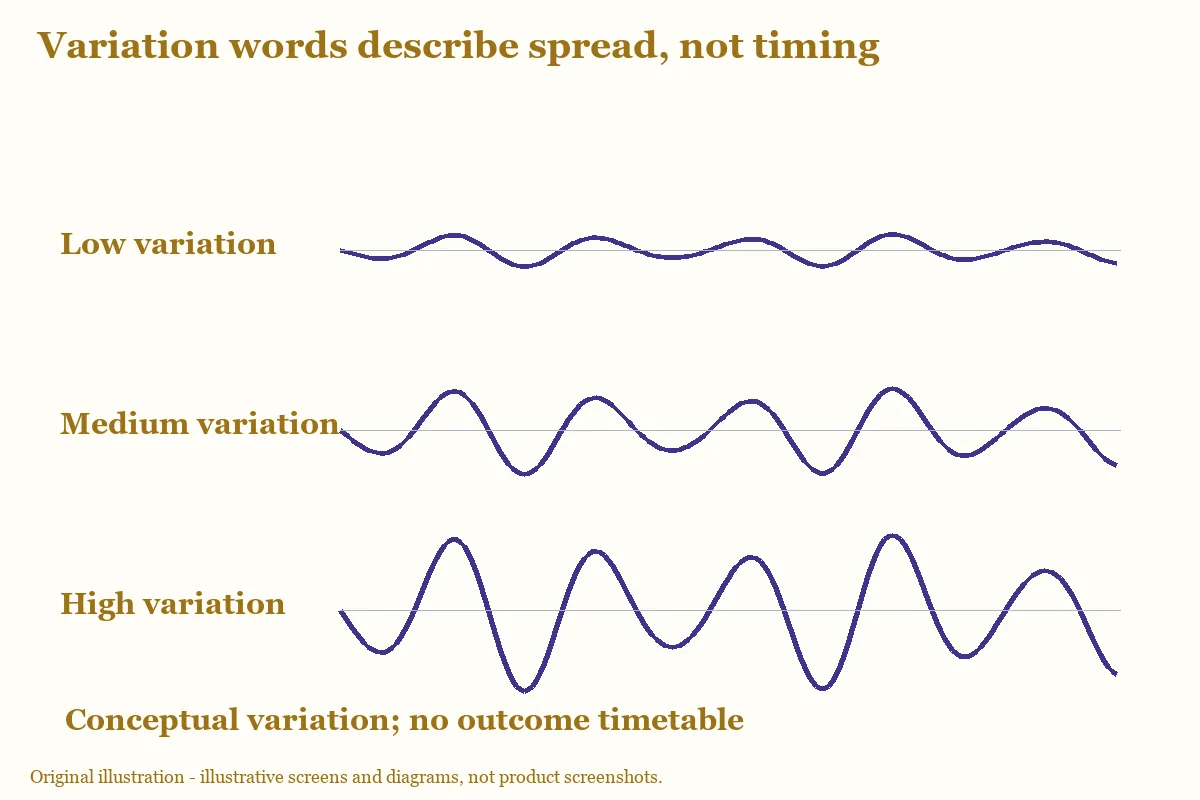
- What the label tries to describe
The label concerns variation rather than a personal forecast. The UK Gambling Commission’s monitoring guide discusses volatility through standard deviation and explains that it affects tolerances around observed return measurements. That is a statistical monitoring context. It is not a promise that an individual session will follow a particular pattern or finish within a comfortable range.
This distinction matters because everyday words can sound more reassuring than the underlying concept warrants. “Low” does not mean harmless, and “high” does not mean an unusually large win is imminent. A reader should not substitute an emotional interpretation of those adjectives for the source’s stated meaning or for an explanation that has not been supplied.
The UK material is included as a technical reference, not as Philippine law. Its discussion of tolerances and measurement helps explain why a short run of outcomes is not enough to interpret a statistical description. We do not copy its sample game figures into a rating for another product or calculate a personal expectation from them.
PG SOFT’s information PDFs use a graphic labelled “SESSION VOLATILITY”. The checked Lucky Neko file includes the words “ENTERTAINING (LOW)”, “ENGAGING (MEDIUM)” and “EXCITING (HIGH)” within that presentation. Those are the publisher’s descriptive words, not this article’s assessment that gambling is entertaining or exciting for a particular reader.
Reference 1 · 2026-10-31. Reference 2 · 2026-10-31. Reference 4 · 2026-10-31.
- Why there is no single industry scale
A single compulsory cross-provider scale was not established by the sources reviewed here, so the broad claim in this heading must remain qualified. The documents show differing vocabulary and presentation; they do not prove that every publisher uses the same thresholds, observation period or mathematical procedure. A universal equivalence therefore remains unverified [待核實].
What remains unverified
The unverified point is the mapping between publishers’ categories. A medium label in one document cannot be converted into a low-medium label in another by intuition. To support that conversion, an editor would need official definitions that use comparable measures and explain their boundaries. Those definitions were not established in this review.
Three documents illustrate the wording problem without solving it. Lucky Neko’s PDF and Mahjong Ways 2’s PDF use a SESSION VOLATILITY presentation; JILI’s checked product page gives “LOW-MED” as its volatility text. The comparison records literal wording. It does not place those products on a newly invented common numerical ladder.
Even two documents from one publisher need their own version references. The Lucky Neko file prints Version 1.0 r945, while the Mahjong Ways 2 file prints Version 1.0r792. Similar presentation is evidence of a shared document style, not proof that every product detail or deployed configuration is the same.
A chart extracted as plain text can also be misleading. Scale captions, axis markers and a product’s position may be flattened into one sequence. It is acceptable to quote clearly legible vocabulary while leaving a specific position unresolved. It is not acceptable to choose whichever nearby adjective seems plausible and present it as an officially confirmed rating.
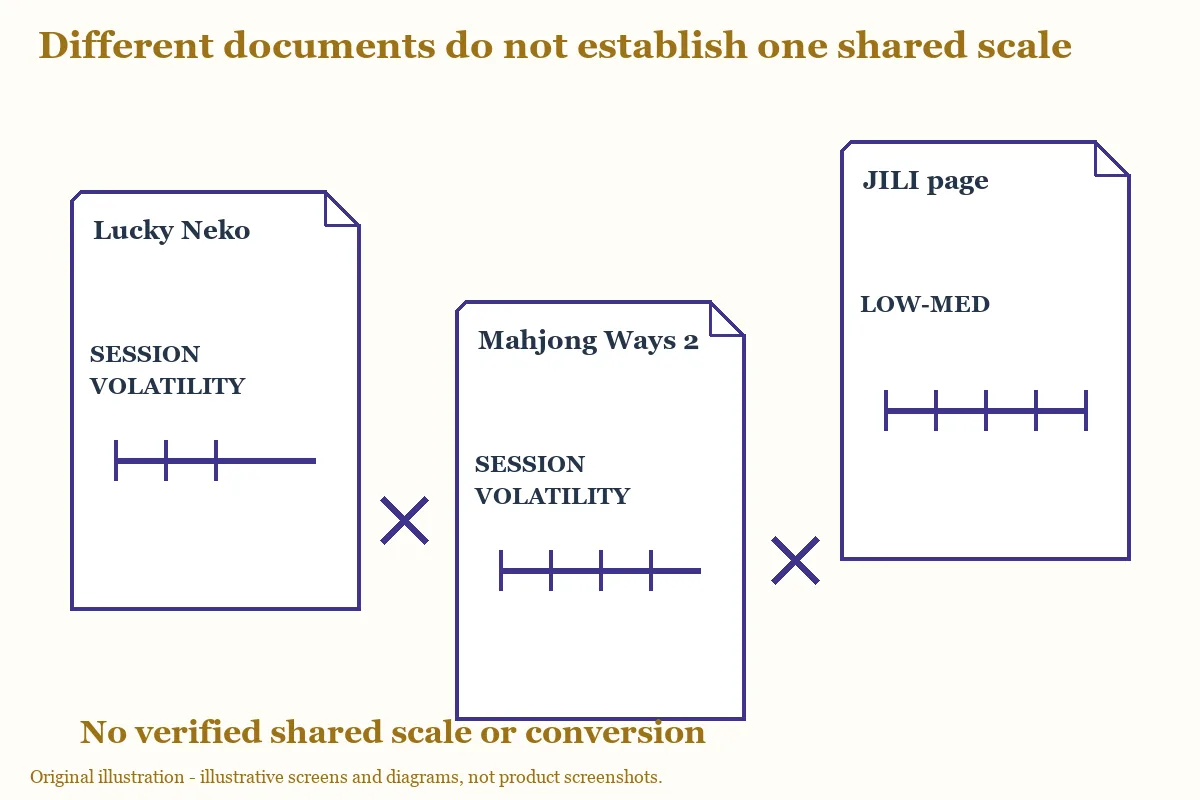
Reader illustration · an original explanatory drawing. Reference 2 · 2026-10-31. Reference 3 · 2026-10-31. Reference 4 · 2026-10-31.
- Volatility vs RTP wording
Return wording and variation wording answer different document questions and should be recorded in separate fields. The monitoring guide calculates observed return from recorded wins and turnover, while also discussing volatility when interpreting the tolerance around that measurement. It does not say that a descriptive volatility adjective is itself a return percentage.
This is a terminology distinction, not a comparison of which game has a better return. The article gives no product RTP values, performs no ranking and offers no betting plan. A figure printed elsewhere on a feature page cannot be read as the numerical definition of a nearby volatility label unless the source expressly connects them.
When editing a glossary note, retain the noun that follows each label. A heading about return belongs with its own definition and reference period. A heading about session volatility belongs with its scale explanation. Combining both into a sentence such as “high means better return” would add a relationship that the checked wording does not support.
No verified same-site RTP glossary URL was provided for this new article. A prospective internal reference should therefore remain an editorial placeholder rather than a fabricated live link. This draft does not send readers to another network site or broaden into the separate slot-rtp-vs-volatility topic.
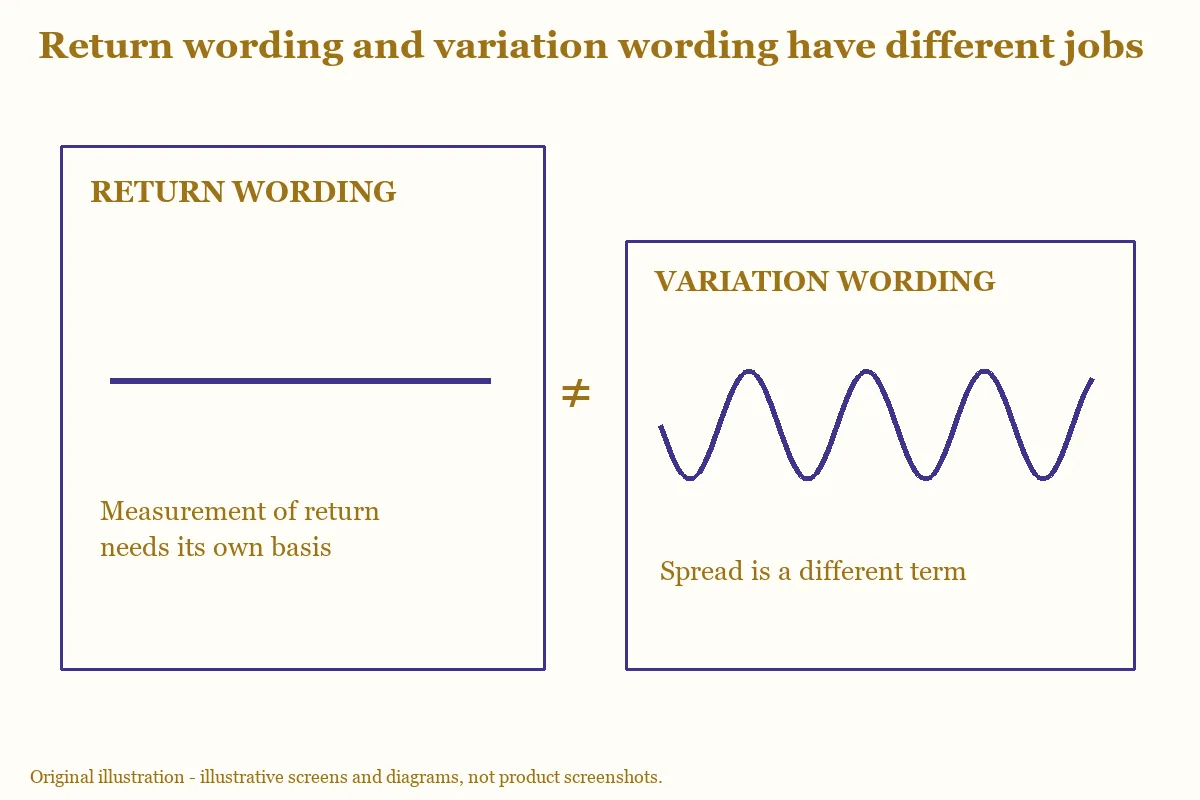
Reader illustration · an original explanatory drawing. Reference 1 · 2026-10-31.
- Reading the label without forecasting
A careful reader treats the label as a document statement and leaves the next outcome unknown. Begin with the exact words, then record the product title, document version or page identity, source URL and retrieval date. Finally note whether the source actually explains the scale. That record is more useful than a standalone badge reading “safe” or “risky”.
Imagine two editorial notes. One says only “medium, therefore a win should arrive soon”. The other says “publisher’s SESSION VOLATILITY wording; scale conversion not established”. The first invents a timetable; the second preserves the evidence boundary. Neither example reports an observed session, and no result history was collected for this article.
Do not use a recent result sequence to rewrite the publisher’s label. A short history and a source-defined classification have different purposes. An unusually quiet or eventful sequence does not, by itself, identify a document’s mathematical method. Likewise, a classification cannot explain away every individual loss or guarantee recovery after continued participation.
If official documents appear inconsistent, preserve both references and investigate the version, product identity and context. A promotional product page, an information PDF and an in-game help panel may not describe the same release. The reason for a real discrepancy remains unverified until the relevant official material resolves it [待核實]. Avoid choosing the most attractive wording merely because it fits a desired article conclusion.
The practical editorial rule is to quote sparingly, explain the source’s scope and leave unsupported comparisons open. Our diagrams are vocabulary aids rather than measured outcome curves. Their wave shapes have no numerical axes and cannot be used to infer probabilities, session length or a point at which a reader should expect a win. That limitation is central to reading volatility language accurately.
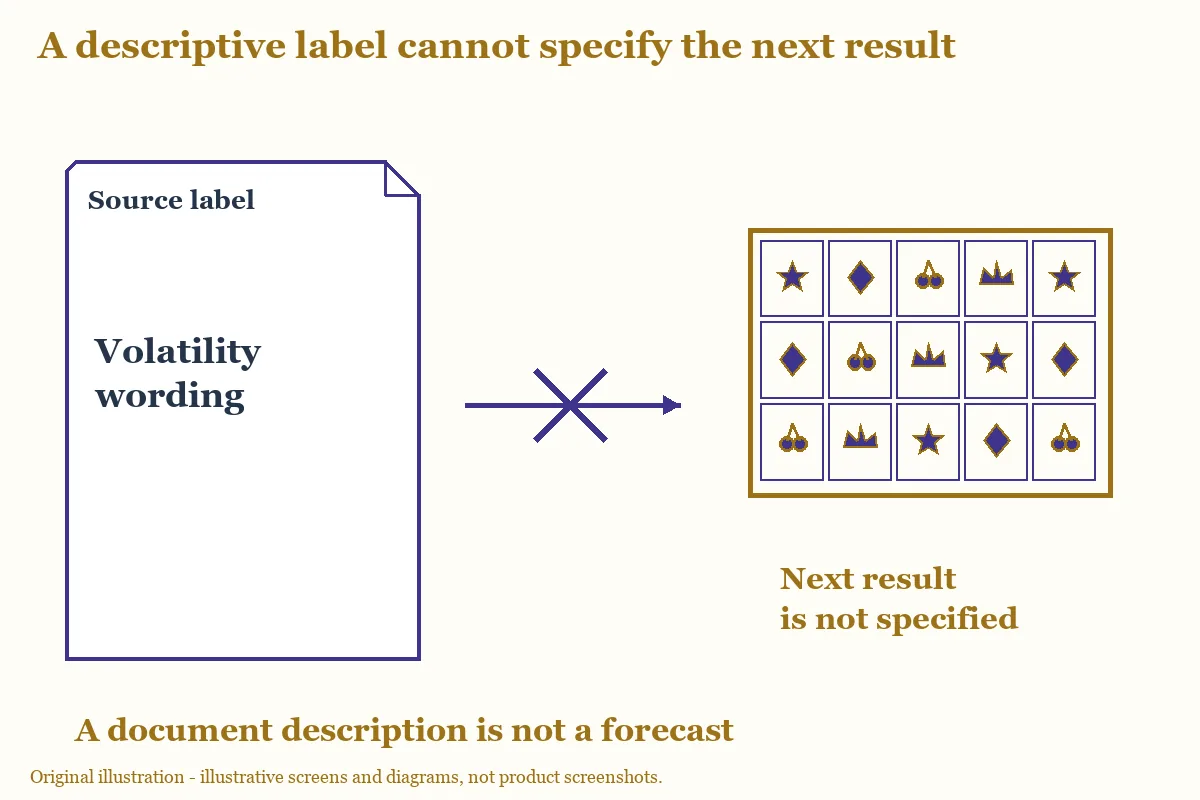
Reader illustration · an original explanatory drawing.
Official references
- Live return to player performance monitoring of games of chance - How to calculate return to player (RTP)
URL subject and content checked; not operator endorsement · Retrieved 2026-10-31.
- GAME COVER
URL subject and content checked; not operator endorsement · Retrieved 2026-10-31.
- GAME COVER
URL subject and content checked; not operator endorsement · Retrieved 2026-10-31.
- Games | JILI Games
URL subject and content checked; not operator endorsement · Retrieved 2026-10-31.
待核實 / Unverified details
- A universal equivalence therefore remains unverified [待核實].
- The reason for a real discrepancy remains unverified until the relevant official material resolves it [待核實].
Questions and answers
- Is there an official volatility scale?
The checked sources did not establish one compulsory cross-provider scale for the Philippines [待核實]. Do not treat a publisher’s visual labels as a universal standard.
Official reference 1 Official reference 2 Official reference 3 Official reference 4
- Does high volatility mean bigger wins soon?
No timing prediction follows from that label. It does not say when an individual will receive a win or recover losses.
Official reference 1 Official reference 2 Official reference 3 Official reference 4
- Why do providers word it differently?
The checked documents use different presentations and vocabulary. Their internal classification methods were not established, so a shared numerical conversion would be speculative [待核實].
Official reference 1 Official reference 2 Official reference 3 Official reference 4
- Where do I find the label?
Look in the identified official product document, feature chart or rules panel. Keep the exact heading and context; if the relevant version does not disclose it, leave it unverified rather than importing another site’s rating.
Official reference 1 Official reference 2 Official reference 3 Official reference 4