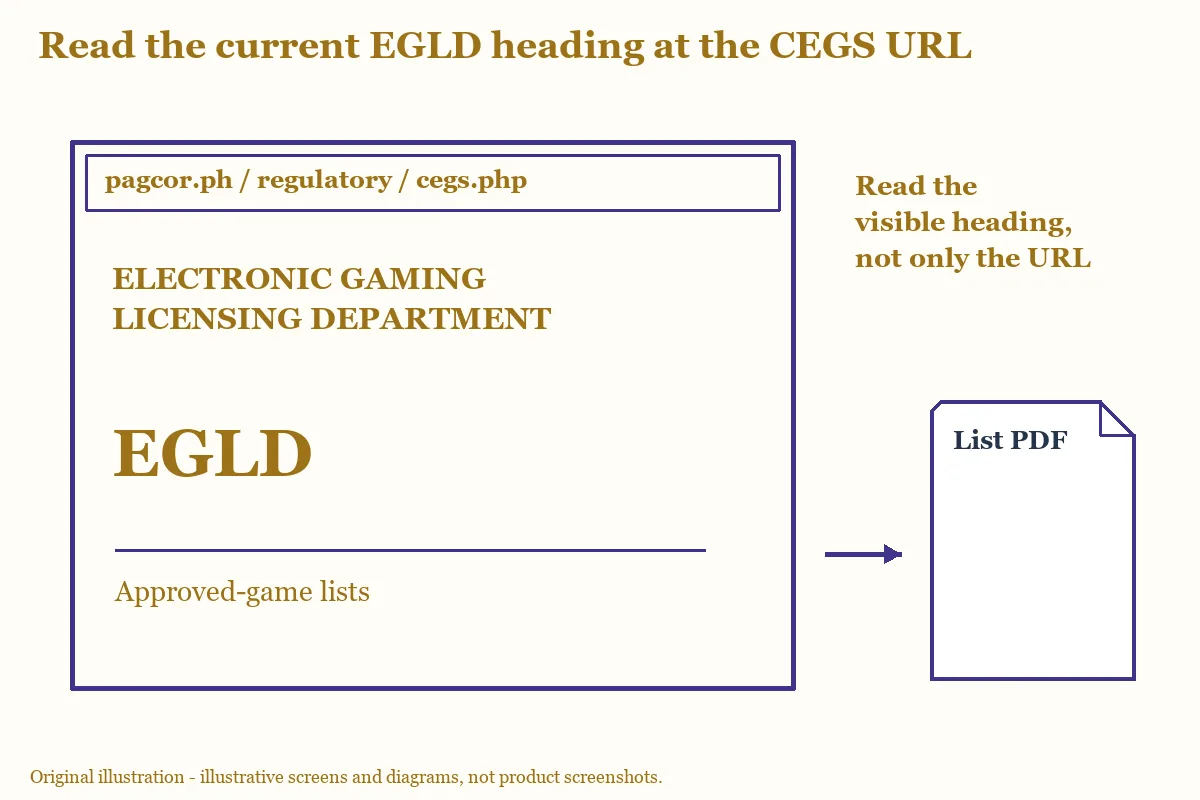
The PAGCOR address ending in cegs.php currently displays an Electronic Gaming Licensing Department page, so read its visible heading rather than guessing an expansion from the URL. The page distinguishes licensing and accreditation work from linked documents such as approved-game lists. To understand any linked record, identify its document type, named entity and stated date first.
Sources: PAGCOR Regulatory site
Talang Laro Editorial Desk / Published 2026-10-31 / Source review 2026-10-31
- Short definition
EGLD means Electronic Gaming Licensing Department in the official page checked for this article. The page describes its role in local gaming operations and their associated online platforms. That is the supported current terminology. An older-looking filename is not sufficient evidence for an alternative department name or for a history of organisational changes.
Readers searching “pagcor cegs meaning” may arrive through the URL itself. The useful answer is therefore partly navigational: this address leads to a page whose present heading and text should control the explanation. We did not establish an official expansion or historical definition of CEGS from the checked page, and that separate question remains unverified [待核實].
The page is a regulatory starting point, not a single certificate covering every link on it. Its sections lead to different materials, including applications, lists and operational information. Before using a document as evidence, ask what the document actually says it is. A title found somewhere on the portal does not automatically answer every licensing question.
Reference 1 · 2026-10-31.
- Terms on the page
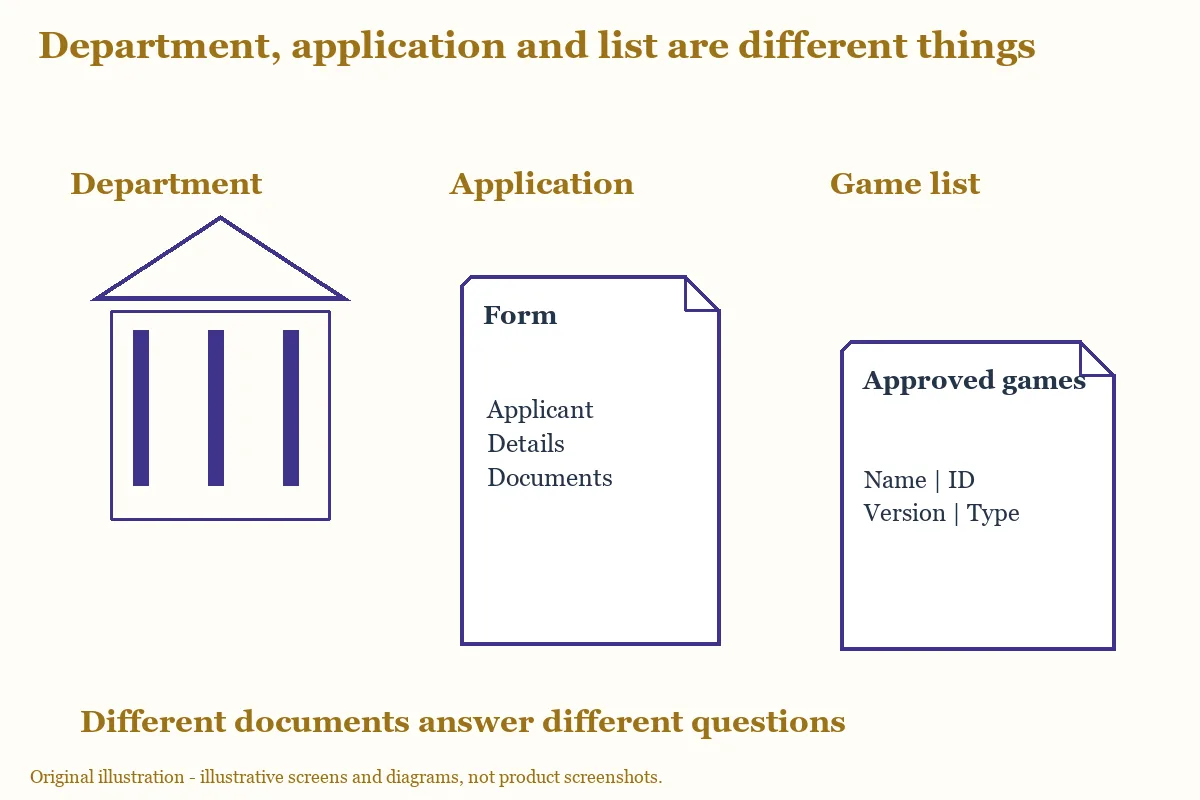
The terms identify different roles in a regulatory process and should not be collapsed into the word “approved”. A department, an application package and a game-list entry are different kinds of things. Keeping those nouns distinct makes a research note more accurate and prevents a broad assurance from being attached to narrow evidence.
EGLD
The official explanation describes EGLD as PAGCOR’s regulatory arm for the specified local gaming operations, apart from land-based casino gaming operations. It discusses service-provider accreditation, evaluation of platforms or systems and games or content, and gaming venue licensing. Those descriptions are the page’s account of its work; this article is a reading guide, not a determination that a particular applicant meets those requirements.
The page also refers to onsite operations and associated online gaming platforms. Do not reduce that wording to a statement that any online address displaying a game is covered. The relationships among an operator, a service provider, a venue and a registered domain require the relevant records rather than an inference from a familiar brand name.
Approved games list
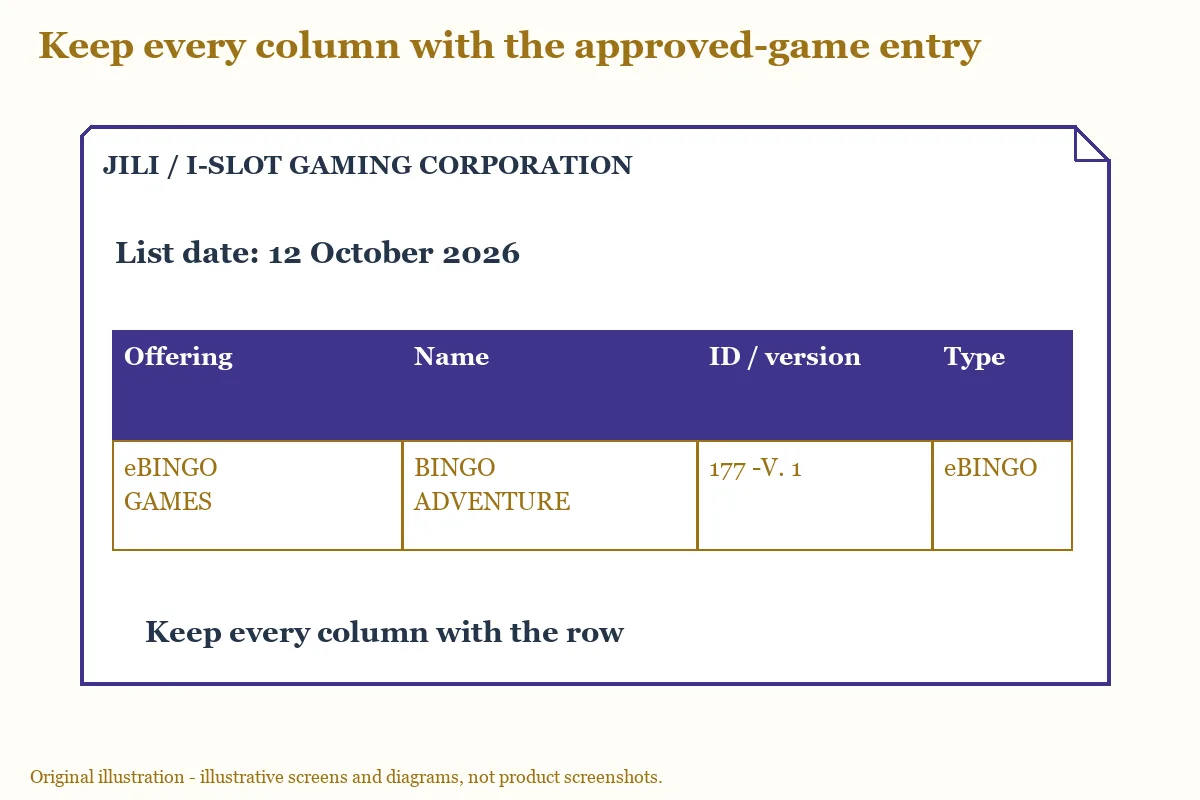
An approved-games list records game entries within the scope stated by its heading and date. The JILI example identifies JILI with I-SLOT GAMING CORPORATION in parentheses and states that it is a list of EGLD-approved electronic games as of 12 October 2026. That wording supports a dated description of the document.
It does not turn the document into a complete guide to every operator carrying JILI content. A provider’s games list and an operator’s current licence or registered domain have different subjects. Use the record suited to the question instead of treating all official PDFs as interchangeable evidence.
App Kit
An application kit normally serves an application process, while a directory path is simply part of a file’s location. The portal has an Application Kits section, but the example PDF’s URL also contains “App Kits” even though the PDF heading identifies an approved-games list. The file’s own heading is therefore more informative than an assumption based on its folder.
For a citation, call the example what it is: the dated JILI approved electronic games list. Do not rename it a JILI operator licence or an application approval letter. A document label should describe the evidence actually opened, not the conclusion a reader hopes to draw from it.
Reader illustration · an original explanatory drawing. Reference 1 · 2026-10-31. Reference 2 · 2026-10-31.
- How a list entry is structured
A useful list entry is read across its columns, preserving the name, offering, identifier/version field and game type. The checked JILI PDF has eight pages and a table headed with those separate fields. Text extracted from a PDF can flatten the layout, so inspect the original row when a version string or wrapped title appears ambiguous.
On the first page, BINGO ADVENTURE appears with the offering eBINGO GAMES, the identifier/version text 177 -V. 1, and the type eBINGO. This is an example of transcription, not an endorsement or a claim about a current operator implementation. Keep the punctuation and source context rather than turning the row into a simplified marketing label.
An identifier can help distinguish similar names, but it must remain tied to its source. Do not assume that an operator’s internal catalogue number, a publisher page number and a regulator’s ID field use the same numbering system. Matching values may be useful evidence; their relationship still needs to be established rather than presumed.
If a field is blank, wrapped or unclear, record that limitation. Filling a gap from a different PDF without identifying the second source can create a row that never existed in either document. A careful evidence sheet separates literal transcription from an editor’s notes about possible matches.
The page number and document date are also part of a usable reference. A source link alone makes it harder to locate one entry in a long list. Record where the row was found and when the file was retrieved, then keep any interpretation in a separate sentence. That makes later updates easier to review.
Reader illustration · an original explanatory drawing. Reference 2 · 2026-10-31.
- What a listing does not certify
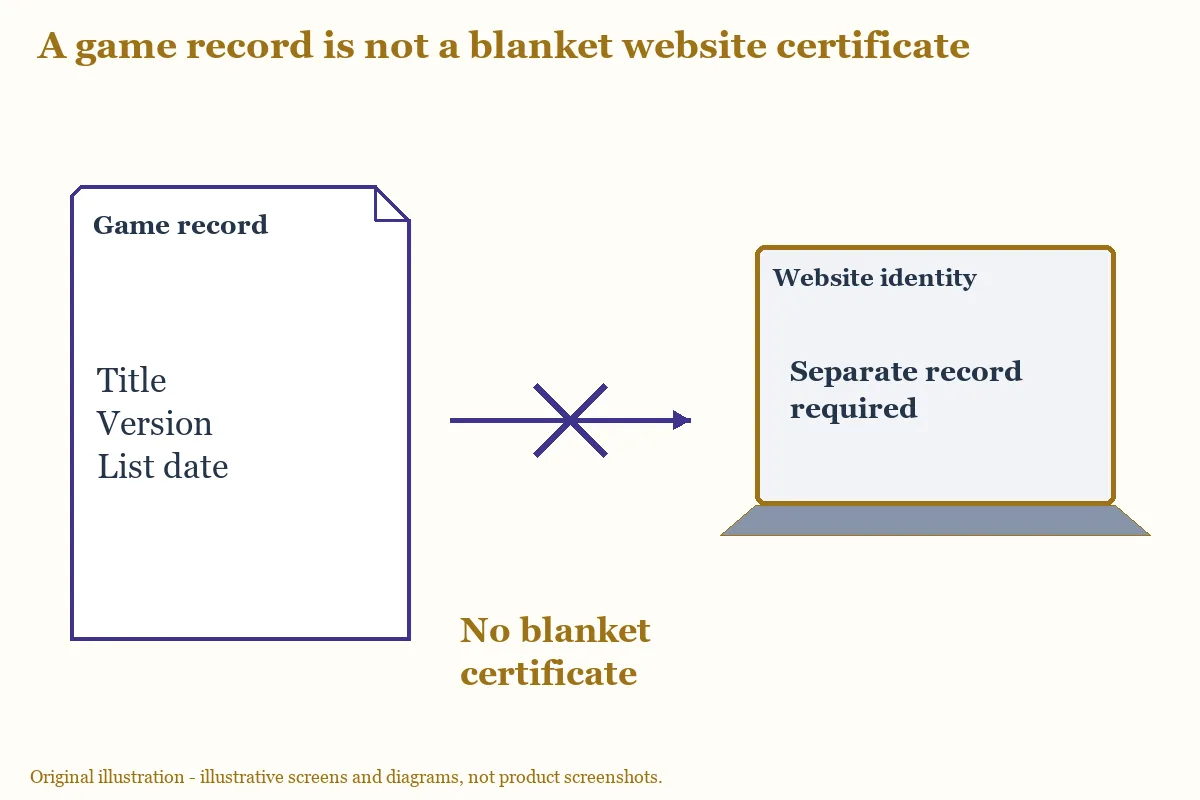
A game-list entry does not certify every website using the same title, every payment arrangement or a future personal result. Its scope is the record described in the document. It is important to stop at that scope even when the document is official and successfully opens. Official provenance does not make an unrelated inference valid.
Likewise, the portal’s existence does not establish that a particular operator or domain is currently registered. The page contains distinct sections for different lists. A current operator-domain question calls for the appropriate current official record, with a matching entity and scope. This guide does not complete that individual check for any service.
Dates should be read literally. The JILI list date is 12 October 2026; our retrieval date is 31 October 2026. Opening an older file later does not issue a new decision. A fixed update schedule was not established [待核實], and an unchanged URL can still deliver a revised document on a later visit.
Finally, these materials do not replace game rules. A row naming a title and version does not provide its complete settlement conditions, screen behaviour or payout mathematics. Keep regulatory identity evidence and product-rule evidence in separate notes. That distinction lets an editor explain what is known without stretching a short record into a guarantee it never made.
Reader illustration · an original explanatory drawing. Reference 1 · 2026-10-31. Reference 2 · 2026-10-31.
Official references
- PAGCOR Regulatory site
URL subject and content checked; not operator endorsement · Retrieved 2026-10-31.
- JILI (I-SLOT GAMING CORPORATION)
URL subject and content checked; not operator endorsement · Retrieved 2026-10-31.
待核實 / Unverified details
- We did not establish an official expansion or historical definition of CEGS from the checked page, and that separate question remains unverified [待核實].
- A fixed update schedule was not established [待核實], and an unchanged URL can still deliver a revised document on a later visit.
Questions and answers
- What does EGLD stand for?
The official page expands it as Electronic Gaming Licensing Department.
- Is an App Kit a licence?
An application kit is application material; a PDF stored under an App Kits path can also be an approved-game list. Neither a folder name nor an unrelated document substitutes for the relevant licence record.
- Where are lists by provider?
The official electronic gaming licensing page has a List of EGLD-Approved Electronic Games section with named links. Open the relevant document and read its heading and date.
- How current is the list?
The JILI document checked here states 12 October 2026. That is its list date, not a guarantee that every linked record is continuously current. A fixed update interval was not verified [待核實].